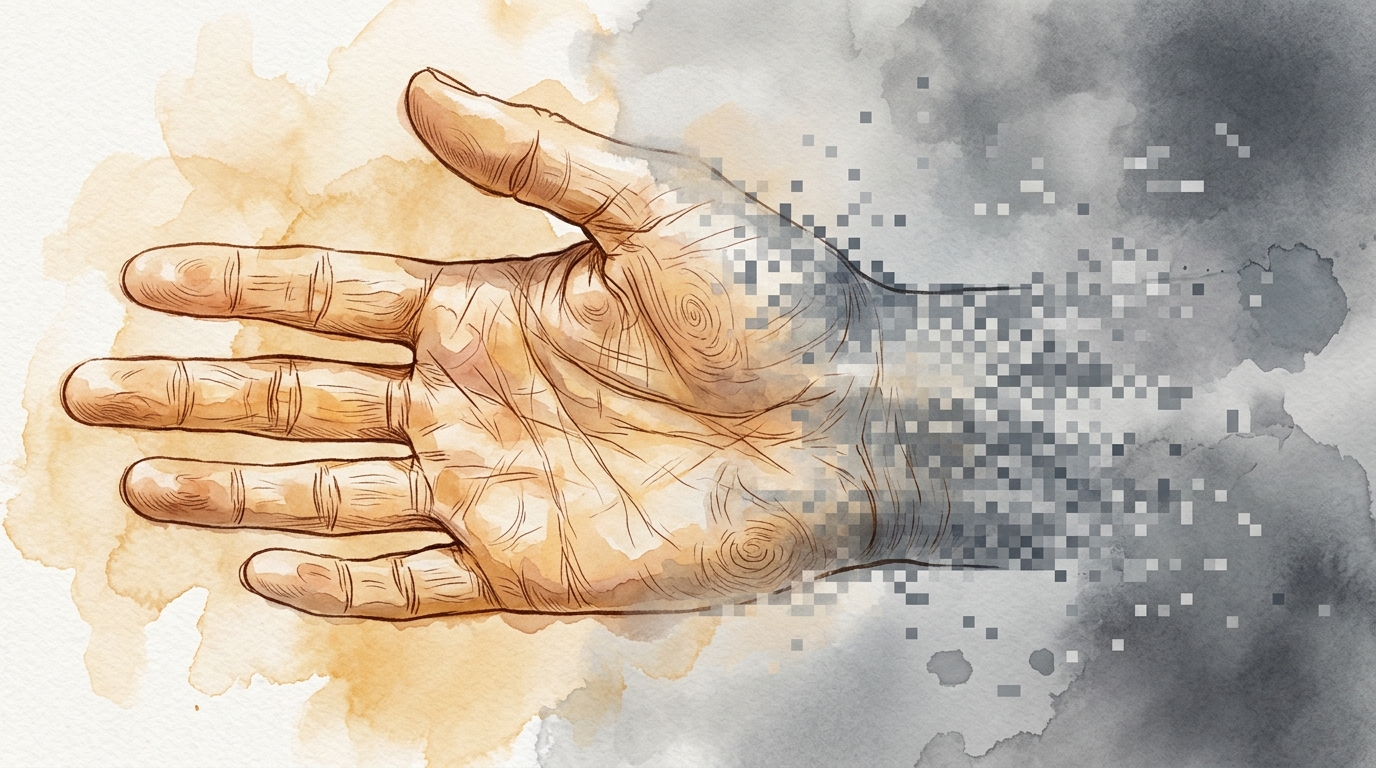
The experiment: one palm photo, one chatbot, one prompt
I photographed my own right palm on a plain white background, good light, fingers slightly spread, the way most palmistry sites tell you to. Then I opened ChatGPT, uploaded the image, and typed a version of the prompt that's been circulating on TikTok and Reddit: "Read my palm. Tell me what my heart line, head line, and life line mean."
ChatGPT answered within seconds. It described a heart line "starting under the index finger, indicating emotional depth and idealism in relationships," a head line suggesting "a balance between logical and creative thinking," and a life line "showing vitality and a strong connection to family." It hedged with a line about palmistry being "a fun tradition rather than scientific fact," which is fair, and then it kept going, adding a paragraph on my "fate line" even though the prompt never asked about one.
The tone was confident. The content was generic. Nothing in the answer referenced where my heart line actually forks, how deep my head line cuts across the palm, or whether my life line has any breaks — details that were visible in the photo I'd just sent it. That gap is the entire subject of this article: what a chatbot can say about palm lines in general, versus what it can actually see in yours.
What a general chatbot can do: recite textbook line meanings
To be fair to ChatGPT, it did the thing it's built to do well: it summarized what palmistry tradition says about each major line, in reasonably accurate textbook terms. The heart line, in that tradition, relates to emotional patterns and how you connect with others. The head line relates to thinking style — analytical versus intuitive. The life line, despite the common myth, isn't about lifespan; it's read as tracking vitality and major life changes. ChatGPT got the basic categories right, and it's worth saying plainly: none of that is a claim about my specific hand. It's a definition, not a diagnosis.
This is where a lot of the ChatGPT palm reading prompt guides stop, and where they oversell what happened. On r/promptingmagic, one thread describing the trend notes that people upload a clear photo of their palm and ask for "a complete palm reading," treating the output as personal. But a chatbot trained on text can retrieve and rephrase what palmistry books say about a heart line existing — that's language pattern-matching, not optical measurement of the line in front of it. If you asked it about your heart line with no photo at all, you'd get nearly the same paragraph. That's the tell.
What it can't do: map the actual lines in your photo
Can AI predict palm reading the way a trained palmist does — by tracing the specific path of your lines? Based on this test, no, not a generic chatbot. My heart line forks near the Mount of Mercury, under my pinky, into two shorter branches. ChatGPT's answer never mentioned a fork at all. It didn't note where my head line sits relative to my life line, whether they start joined or separated (mine start slightly apart, which traditionally gets read as independence in decision-making), or that my life line has a faint break around the midpoint with a second line running parallel just inside it — a detail palmists usually flag as significant.
None of that appeared in the output, not because the trend is fraudulent, but because a general-purpose language model isn't built to measure line depth, curvature, or branching points in an uploaded image with the pixel-level attention that task requires. It generates plausible palmistry language; it doesn't run the image through a process designed to locate and trace hand lines.
Forks, depth, and branches are yours alone — generic answers aren't
This is the actual failure mode, stated plainly: forks, depth, and branch points are specific to your hand. A chatbot answer that doesn't mention any of yours by location is describing palmistry as a subject, not your palm as an object. If you want to see what tracing those specifics actually looks like, a purpose-built palm analysis from your actual photo is built around exactly that task rather than around conversational text generation.
Side by side: generic AI vs. purpose-built palm analysis
| Criteria | Generic AI chatbot (ChatGPT) | Purpose-built palm analysis |
|---|---|---|
| Identifies major lines exist | Yes, by name | Yes, by name |
| Traces your heart line's actual fork/end point | No — not observed in test | Located and described from your photo |
| Notes head line depth or curve specific to you | No — generic phrasing only | Measured against your photo |
| Flags breaks, islands, or parallel lines | Not mentioned in test output | Identified and explained |
| Reads mounts relative to your line placement | Not addressed | Addressed |
| States confidence/limits of the reading | Sometimes, in a disclaimer sentence | Stated per feature |
| What happens to your uploaded photo | Unclear to the user, by default | Should be stated plainly by any tool you use |
The chatbot column isn't wrong so much as incomplete — it's answering "what does a heart line mean" when the real question is "what does my heart line show."
The privacy question nobody thinks to ask a chatbot
Almost none of the ChatGPT palm reading prompt guides address what happens to your photo after you upload it, and that's a real gap, because a palm photo is biometric data — it can contain a fingerprint-adjacent level of unique physical detail, not just a picture like a sunset. A cybersecurity write-up on the trend put it directly: the ChatGPT palm reading trend can expose biometric data permanently, and if an account tied to that image is ever compromised or the data leaked, that exposure doesn't reset the way a password can.
Here's what's actually known, stated plainly rather than guessed at: general-purpose chatbots typically retain uploaded images as part of your conversation history and may use conversations to improve their models unless you've turned that setting off, and account-level breaches or leaks would expose whatever's stored there, images included. Exactly how long any given service keeps an image, and whether it's used for training, depends on that service's own settings and policies at the time you upload — details worth checking yourself rather than assuming. What's not known, and what most prompt guides never mention, is where that photo sits six months later or who else's systems touch it in between. One Reddit commenter, in a thread questioning the trend, put the accuracy skepticism this way: "how is it supposed to be accurate if it just feeds off whatever info is given and spits it back" — a fair question to ask about both the reading and the data behind it.
Any tool asking for a palm photo should tell you plainly what happens to that image. If it doesn't say, that's your answer.
When a chatbot answer is enough — and when you want your own lines mapped
A chatbot answer is enough if you want the vocabulary — what a heart line generally represents, what a head line tracks, what a life line is traditionally read for — the same way it's enough to look up what a word means before deciding how it applies to your sentence. It's also fine as entertainment, the same spirit as a horoscope app: read it, enjoy it, don't restructure your week around it.
It's not enough if what you actually want answered is about your hand — where your heart line forks, whether your head line's depth suggests one reading over another, what that break in your life line is doing. A generic chatbot, based on this test, won't locate any of that in your photo; it will describe the category and leave the specifics to you. That's the honest line between the two, and it's worth being decisive about it rather than hedging: if your question starts with "what does my line show," you need something built to trace your photo, not summarize palmistry in general. For background on why the accuracy question is more complicated than "yes" or "no" even with a trained reader, the accuracy question most palm reading sites won't answer is worth reading next, alongside a look at which palm you should even be photographing before you run any version of this test yourself.