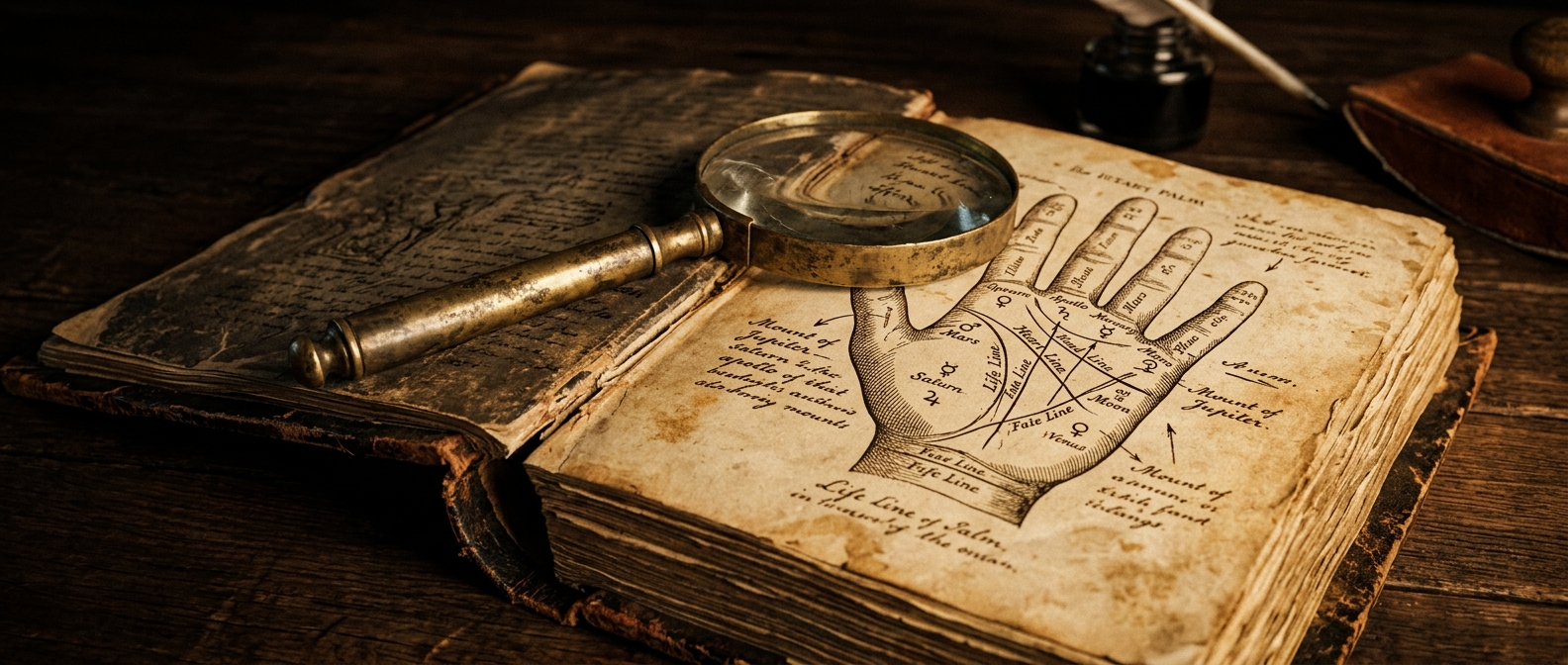
A count who wasn't a count sat in a London drawing room in the 1890s, holding the hand of a man who would go on to write "Adventures of Sherlock Holmes." He told him things about his character that made the newspapers the next day. That performance, repeated for a few decades with a rotating cast of the famous, did more to shape how palm reading looks and sounds today than any Vedic text, Greek philosopher, or medieval Romani reader who came before him. The practice existed for centuries before he arrived. It survived, in its current recognizable form, largely because of what he did to sell it.
Where the word 'palmistry' actually comes from
"Palmistry" is built from plain English: palm, the part of the hand, plus the old suffix "-istry," meaning a practice or craft, the same pattern behind "chemistry" or "dentistry." No mystery there. The word simply names the practice of doing something with the palm.
"Chiromancy" is the older and more technical term, and its etymology is the real story. It comes from the Greek "kheir," meaning hand, combined with "manteia," meaning divination — the same root that gives us "necromancy" (divination by the dead) and "pyromancy" (divination by fire). Chiromancy, then, translates literally to "divination by the hand." That is a meaningfully different claim than "reading character traits," and the distinction matters: one frames the hand as a diagnostic tool for temperament, the other as a window onto fate itself.
Britannica defines palmistry as the practice of reading character traits and divining the future by interpreting the lines and undulations on the hand — which is really both etymological threads at once, character-reading and fate-divination, fused into one word by the time English absorbed it. That dual meaning has never fully resolved. Every palmist since has had to decide, implicitly, whether they're reading a personality or predicting an outcome. Cheiro, as we'll see, sold both at once, and it's a large part of why his brand of chiromancy outlasted its rivals.
The Aristotle manuscript — and whether Aristotle wrote it
The claim shows up in nearly every palmistry history: a manuscript on chiromancy, supposedly found on an altar dedicated to Hermes, was presented to Alexander the Great, and Aristotle himself is credited as either its author or its champion. It's a good story. It's also, by the consensus of classical scholars, not true in the way it's usually told.
The text in question — sometimes catalogued as a pseudo-Aristotelian work on physiognomy and palm-reading — was almost certainly written centuries after Aristotle's death, then attributed to him later to borrow his authority. This was a common practice in antiquity; plenty of texts got an authorship upgrade because Aristotle's name carried more weight than an anonymous author's. So the honest verdict, and this article's own editorial judgment rather than a settled historical fact beyond dispute, is that the "Aristotle wrote the first palmistry manuscript" claim should be treated as disputed tradition, not documented history. Aristotle did write about physiognomy — reading character from physical features generally — and that's real. The specific palm-reading manuscript credited to him is very likely a later forgery wearing his name.
If you're looking for a single "father of palmistry," there isn't a clean answer, and Aristotle doesn't fill that role on the current evidence. The practice has too many independent points of origin — Indian, Chinese, Greek, Mesopotamian — to credit one founder. The closest thing to a father of the modern practice, as this article argues, is a nineteenth-century Irishman who never claimed the title outright but built the industry that made the question worth asking.
Centuries on the margins: Romani readers and the Church's disapproval
For most of European history, reading palms was not a respectable profession — it was closer to a suspect one. Chiromancy traveled through Arab and Jewish scholarly traditions that preserved and translated earlier texts, and it moved through Europe largely carried by Romani communities, who kept the practice alive as an oral and traveling trade well after institutional Europe turned against it.
That institutional turn was formal and dated, not vague suspicion. A documented timeline of palm reading in the UK notes that in 1586 the Catholic Church officially condemned divinatory arts in a papal bull, placing chiromancy alongside astrology and other practices the Church classed as illegitimate attempts to know what only God should know. This is a documented historical event, not a later legend — a specific bull, a specific year, a specific institutional target.
What the condemnation actually meant on the ground is where tradition and fact diverge. That palmistry was seen as suspect, sometimes prosecuted, sometimes practiced underground, is documented. That any particular palmist reader from this era read any particular fate correctly, or that the Church's objections were theologically airtight rather than politically convenient, is tradition-based interpretation layered on top of a real event — worth flagging every time a history piece states it as flatly as the bull itself. The practice didn't die from the ban. It went private, went itinerant, and waited for a printing press and, eventually, a showman.
Cheiro: the Irish palmist who read for crowned heads
William John Warner was born in Ireland in the 1860s and reinvented himself, almost entirely through self-authored biography, as "Cheiro" — a stage name built from "chiro," the hand root again, doing double duty as both branding and etymology lesson. Where he actually learned palmistry is murky by his own design; his autobiographical accounts describe travel and study in India, but these are his own retellings, not independently verified biography.
What is verifiable is the outcome: by the 1890s and into the early 1900s, Cheiro was operating as a society palmist in London, charging fashionable clients for readings and publishing books under his own name that sold at a scale no previous chiromancy text had reached. If there's a candidate for the most famous palmist in the world, living or dead, it's still him — not because he founded the practice, but because he's the one name in palmistry history most casual readers can produce without prompting, more than a century after his death.
The clients he claimed — Twain, Edison, the Prince of Wales
Cheiro's autobiography and promotional materials name an extraordinary client list: Mark Twain, Thomas Edison, Oscar Wilde, and the future King Edward VII among them. Some of these claims have independent support — Twain and Wilde's social circles overlapped with the London society scene Cheiro operated in, and period accounts corroborate that Cheiro's parlor was a fashionable stop for exactly this crowd. But the specific claim that he read for Edison, or for the Prince of Wales personally, comes down to Cheiro's own account in his memoirs, not an independent, citable source confirming the encounter happened as described. Readers repeating "Cheiro read Mark Twain's palm" as settled fact are repeating his marketing, not documented history — a distinction worth keeping even when the story is genuinely fun to tell.
Why his books outsold every palmistry text before them
The content of Cheiro's system wasn't dramatically new — mounts, lines, the same basic vocabulary chiromancers had used for generations. What was new was the packaging: first-person celebrity anecdotes, a mysterious personal origin story, confident short-form predictions readers could apply to themselves without a teacher. He wrote for a mass market, not a scholarly one, at exactly the moment cheap printing and a literate middle class made that market enormous.
How Cheiro's version became the palmistry we still use
Cheiro wasn't operating in a vacuum. Wikipedia's palmistry entry notes that the modern revival of chiromancy actually began earlier, with Captain Casimir Stanislas D'Arpentigny's published work classifying hand shapes — the system that still underlies how palmists categorize "elemental" or "practical" hands today. D'Arpentigny did the systematizing. Cheiro did the popularizing, and popularizing is why his terminology, not D'Arpentigny's, is what survives in mass-market palmistry books and phone apps now.
The specific vocabulary readers encounter today — "Mount of Venus," "the Girdle of Venus," dramatic naming for lines and zones across the palm — owes more to Cheiro's flair for memorable labeling than to any older textual tradition. He took existing chiromantic concepts, some centuries old, and renamed and dramatized them into a coherent, sellable system with his own books as the reference text. That's the actual mechanism behind "Cheiro's influence": not new discoveries about the hand, but a marketing and packaging innovation that made an old practice legible and desirable to a mass Victorian audience, then durable enough to outlast him by more than a century.
What the history books get wrong about palm reading's origins
The most common misconception is treating palmistry's origin story as a single clean line — India to Aristotle to the Church to Cheiro — when it was really several parallel traditions that occasionally crossed paths. A peer-reviewed overview of cheiromancy notes that palmistry is generally considered an occult science believed to have originated in India, spreading from Asia across the world over time, and mentions William John — Cheiro — by name as part of that spread, which is a useful corrective to treating him as a European invention rather than the latest stop on a much older route.
Is there any science behind palmistry? The honest answer: not in the sense of lines predicting personality or future events — no peer-reviewed research supports that specific claim, and it remains outside what evidence-based medicine or psychology recognizes as testable. What does have a documented biological basis is much narrower — certain hand-crease patterns, like the single crease seen in simian lines, are studied in genetics and dermatoglyphics as markers correlated with some developmental conditions, which is a real but far more limited finding than "your love life is written on your palm." Palmistry's interpretive claims and clinical dermatoglyphics are different fields that happen to look at the same body part; conflating them is where a lot of "is palm reading accurate" confusion starts, and it's worth reading the accuracy question most palm reading sites won't answer if that's the question that brought you here.
None of this makes the tradition worthless as tradition — chiromancy has a real etymology, a real and documented persecution history, and a real Victorian celebrity industry behind it, all independently checkable. It just means the "4,000-year unbroken lineage back to a single founder" version sold in most timelines is smoother than the record actually supports. If you're curious what a modern reading of that same tradition looks like applied to an actual hand rather than a history lesson, a palm reading that takes minutes, not an appointment is the more useful next stop than another origin story.